
Small Company under Companies Act, 2013 – Definition, Benefits & Compliance Relaxations
Introduction
The concept of a Small Company under the Companies Act, 2013 was introduced to reduce the compliance burden on small and growing businesses in India. The Government has provided several relaxations and exemptions to encourage entrepreneurship, ease of doing business, and support MSMEs operating in corporate form.
With the latest MCA amendment effective from 01-12-2025, the eligibility limits for Small Companies have been significantly enhanced, enabling more private companies to avail compliance benefits.
Meaning of Small Company
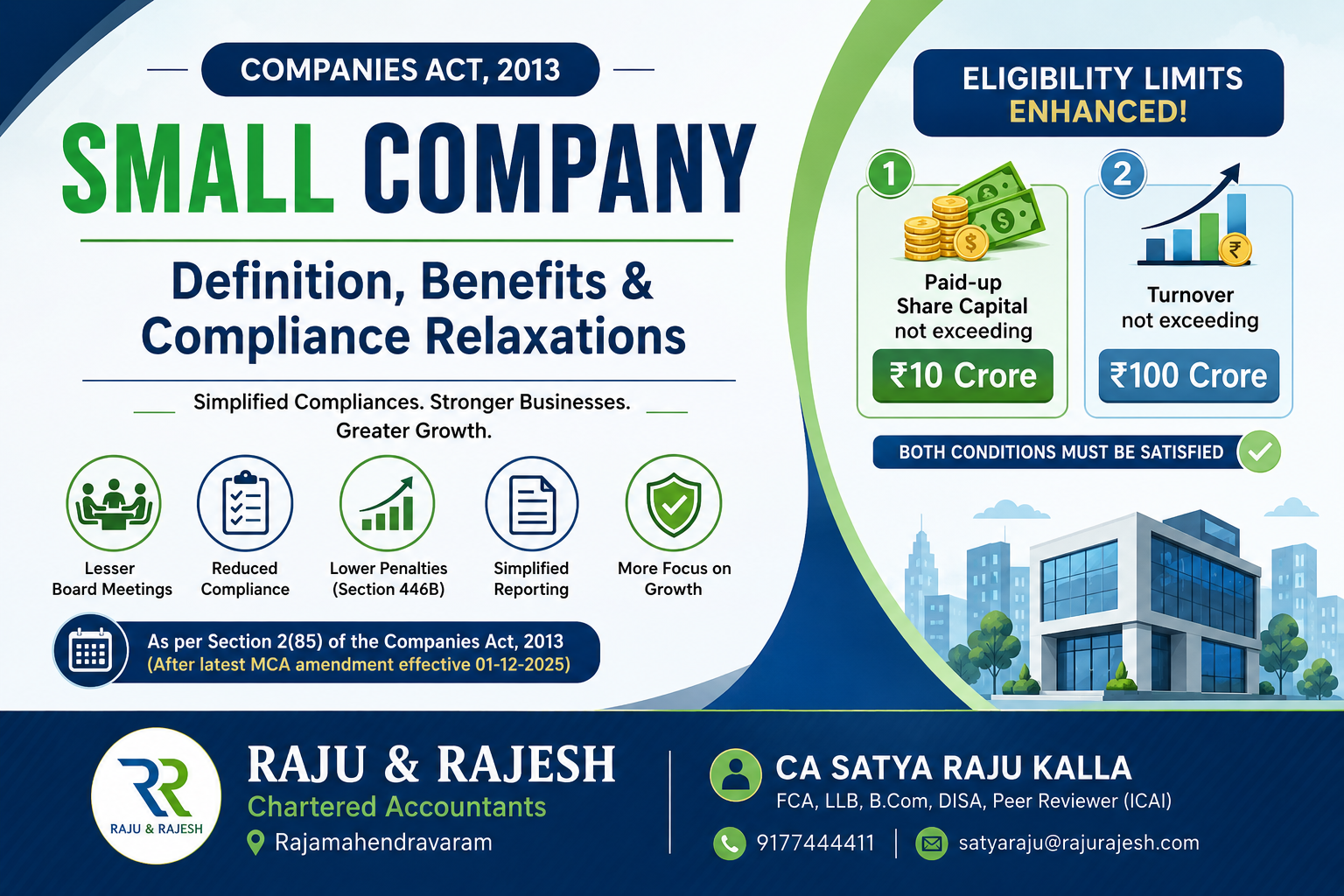
As per Section 2(85) of the Companies Act, 2013, a Small Company means a company, other than a public company, having:
1. Paid-up Share Capital
Not exceeding ₹10 Crore
2. Turnover
Not exceeding ₹100 Crore as per the immediately preceding financial year.
Both conditions must be satisfied simultaneously for a company to qualify as a Small Company.
Companies Not Eligible as Small Companies
The following companies cannot be classified as Small Companies:
-
Public Company
-
Holding Company
-
Subsidiary Company
-
Section 8 Company
-
Company governed by any Special Act
Major Compliance Benefits Available to Small Companies
1. Lesser Number of Board Meetings
A Small Company is required to conduct only:
-
2 Board Meetings in a year
-
One meeting in each half of the calendar year
-
Minimum gap of 90 days between meetings
Benefit:
Reduces administrative burden and compliance costs for management.
2. CARO Reporting Not Applicable
Under the Companies (Auditor’s Report) Order (CARO), reporting requirements are extensive for auditors.
However, CARO is generally not applicable to eligible Small Companies.
Benefit:
-
Simpler audit process
-
Reduced audit documentation
-
Lower compliance complexity
3. Cash Flow Statement Not Mandatory
As per Section 2(40), Small Companies are exempted from preparing a Cash Flow Statement as part of financial statements.
Benefit:
Financial statement preparation becomes easier and more cost-effective.
4. Lesser Penalties under Section 446B
One of the biggest advantages available to Small Companies is reduced penalties.
Section 446B provides:
-
Penalty can be reduced to 50% of normal penalty
-
Subject to prescribed maximum limits
Applicable to:
-
Company
-
Directors
-
Officers in default
Benefit:
Provides major relief in procedural and technical non-compliance matters.
5. Abridged Annual Return
Small Companies can file an abridged version of Annual Return with reduced disclosure requirements.
Benefit:
-
Simpler annual filing process
-
Less documentation burden
-
Faster compliance management
6. Auditor Rotation Provisions Not Applicable
Mandatory auditor rotation provisions do not apply to Small Companies.
Benefit:
-
Continuity in audit process
-
Better understanding of business operations
-
Reduced transition and onboarding costs
7. Simplified Board’s Report
The Board’s Report requirements are comparatively simpler for Small Companies.
Benefit:
-
Reduced disclosures
-
Lower governance reporting burden
-
Easier annual compliance preparation
8. Internal Financial Control (IFC) Reporting Relaxation
Auditor reporting on Internal Financial Controls is generally not applicable to Small Companies.
Benefit:
Reduces compliance and audit complexity significantly.
Practical Advantages for Businesses
The Small Company concept is highly beneficial for:
-
Startups
-
Family-managed businesses
-
Professional firms converted into companies
-
Growing MSMEs
-
Closely held private companies
These relaxations help businesses focus more on growth rather than procedural compliances.
Important Practical Point
A company must evaluate its eligibility every financial year based on:
-
Paid-up capital
-
Turnover of preceding FY
-
Nature/status of company
If thresholds are crossed, the company may lose Small Company status and corresponding exemptions.
Conclusion
The enhanced limits for Small Companies represent a significant step towards improving the ease of doing business in India. Companies falling within the prescribed limits should proactively evaluate their eligibility and avail the available compliance relaxations.
Proper classification can substantially reduce:
-
Compliance costs
-
Audit burden
-
Regulatory exposure
-
Administrative workload
At the same time, companies should ensure proper governance and timely statutory compliance to fully benefit from these exemptions.
CA SATYA RAJU KALLA
FCA, LLB, B.Com, DISA, Peer Reviewer (ICAI)
RAJU & RAJESH
Chartered Accountants
Rajamahendravaram
📞 9177444411
📧 satyaraju@rajurajesh.com
Have Questions? We're Here to Help
Get expert advice from RAJU & RAJESH. Reach out to discuss your requirements.