
Nation First: Understanding PM Modi’s 7 Appeals to Indians — An Economic and Strategic Perspective
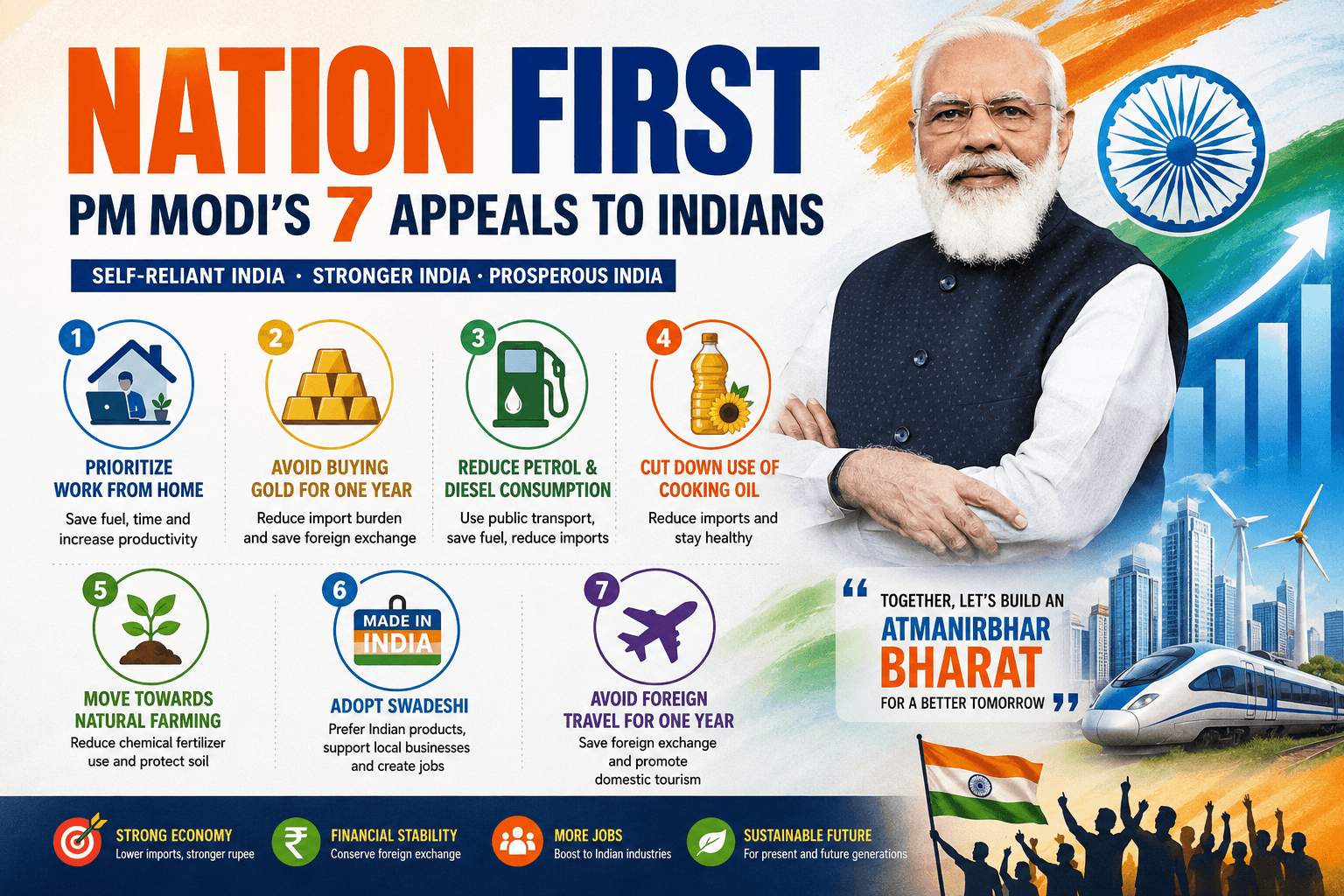
India today stands at a very important economic and geopolitical crossroads. Prime Minister Narendra Modi’s recent appeals to citizens — ranging from reducing imports to avoiding unnecessary foreign travel — are not merely lifestyle suggestions. They reflect a larger national strategy aimed at protecting India’s economy, strengthening self-reliance, conserving foreign exchange, and preparing the country for uncertain global conditions.
For professionals, taxpayers, business owners, investors, and common citizens alike, these appeals deserve careful analysis. As Chartered Accountants, we must look beyond political narratives and understand the economic logic, fiscal implications, and long-term national impact behind these messages.
The 7 Appeals by PM Modi
The Prime Minister appealed to citizens to:
-
Prioritize Work From Home wherever possible
-
Avoid buying gold for one year
Need help with this? Talk to RAJU & RAJESH → -
Reduce petrol and diesel consumption
-
Cut down use of cooking oil
-
Reduce dependence on chemical fertilizers and move towards natural farming
Need help with this? Talk to RAJU & RAJESH → -
Prefer Indian products and adopt Swadeshi
-
Avoid foreign travel for one year
At first glance, these may appear to be simple behavioral recommendations. However, collectively they indicate something much deeper: India is trying to reduce pressure on imports, foreign exchange reserves, and inflationary risks.
What Is Happening Globally Right Now?
The world economy is currently under severe stress due to multiple simultaneous factors:
-
Rising geopolitical tensions
-
Global trade disruptions
-
Oil price volatility
-
Supply chain uncertainties
-
Currency fluctuations
-
Increasing protectionism among nations
-
Slowing global growth
India imports large quantities of:
-
Crude oil
-
Gold
-
Electronic goods
-
Fertilizers
-
Edible oils
-
Defence equipment
-
Industrial raw materials
Whenever global uncertainty increases, import costs rise sharply. This puts pressure on India’s trade deficit and weakens the rupee.
Why Is the Government Concerned?
India remains one of the fastest-growing economies in the world. However, growth alone is not enough. The government must also maintain:
-
Stable foreign exchange reserves
-
Controlled inflation
-
Currency stability
-
Energy security
-
Food security
-
Fiscal discipline
When imports rise aggressively while exports slow down, the country faces pressure on its balance of payments.
This is where these appeals become economically significant.
Understanding Each Appeal Economically
1. Prioritize Work From Home
Work From Home reduces:
-
Fuel consumption
-
Traffic congestion
-
Pollution
-
Energy costs
-
Office operational expenses
Less commuting means lower fuel imports. Since India imports a majority of its crude oil requirements, even small reductions in fuel consumption can save billions in foreign exchange annually.
From a business perspective, hybrid working also improves efficiency and reduces infrastructure costs.
2. Avoid Buying Gold for One Year
India is one of the world’s largest consumers of gold.
However, gold is largely imported. Excessive gold imports:
-
Increase trade deficit
-
Drain foreign exchange reserves
-
Weaken the rupee
-
Create non-productive savings
Economically, idle gold does not generate productivity. The government prefers household savings to move toward:
-
Equity markets
-
Manufacturing
-
Infrastructure
-
Banking instruments
-
Productive investments
This appeal is extremely significant from a macroeconomic standpoint.
3. Reduce Petrol & Diesel Consumption
India imports nearly 85% of its crude oil requirements.
When oil prices rise globally:
-
Transportation costs increase
-
Inflation rises
-
Logistics become expensive
-
Government subsidy burden increases
Encouraging public transport and reduced fuel usage helps:
-
Lower import dependency
-
Control inflation
-
Improve environmental sustainability
This is not merely an environmental appeal — it is an economic defense mechanism.
4. Cut Down Cooking Oil Usage
India imports a substantial portion of edible oils.
When international edible oil prices increase, India’s food inflation rises sharply. Reducing excessive consumption can:
-
Reduce import burden
-
Improve public health
-
Control food inflation
This is both an economic and health-oriented recommendation.
5. Move Towards Natural Farming
India spends heavily on fertilizer subsidies every year.
Chemical fertilizers are often dependent on imported raw materials. Rising global fertilizer prices directly impact:
-
Government expenditure
-
Fiscal deficit
-
Agricultural sustainability
Natural farming aims to:
-
Reduce subsidy dependence
-
Improve soil health
-
Lower import requirements
-
Increase long-term sustainability
This is a strategic agricultural reform direction.
6. Adopt Swadeshi — Use Indian Products
This appeal directly supports:
-
Domestic manufacturing
-
MSMEs
-
Employment generation
-
Local entrepreneurship
Every imported product replaced by an Indian product strengthens:
-
Indian industry
-
Tax collections
-
Employment opportunities
-
GDP contribution
The “Make in India” and “Atmanirbhar Bharat” vision is deeply connected to this appeal.
For businesses, this may create major opportunities in:
-
Manufacturing
-
Branding
-
Local supply chains
-
Consumer goods
-
Technology development
7. Avoid Foreign Travel for One Year
Foreign travel causes outflow of foreign currency through:
-
Air travel
-
Hotels
-
Shopping
-
Education expenses
-
Tourism spending
Encouraging domestic tourism helps retain money within India’s economy.
This also supports:
-
Indian hospitality industry
-
Local businesses
-
Domestic employment
Is India Facing a 1991-Like Crisis?
This is the most important question.
The answer is: No, India is not currently in a 1991-level crisis.
However, the government appears to be taking preventive measures to ensure such a situation never arises.
What Happened in 1991?
India faced a severe Balance of Payments crisis in 1991 due to:
-
Extremely low foreign exchange reserves
-
High imports
-
Weak exports
-
Gulf War oil shock
-
Fiscal mismanagement
-
External debt pressure
India reportedly had reserves sufficient for only a few weeks of imports.
The country had to:
-
Pledge gold reserves
-
Seek IMF assistance
-
Undertake economic liberalization reforms
That crisis changed India forever.
Why Today Is Different
India today is far stronger than in 1991 because:
-
Foreign exchange reserves are significantly larger
-
Banking systems are stronger
-
GST improved tax collections
-
Digital economy has expanded
-
Manufacturing capability improved
-
Export base diversified
-
Infrastructure investments increased
However, global uncertainty can still create pressure if imports rise uncontrollably.
The government’s current approach appears preventive rather than reactive.
The Bigger Strategic Message
These appeals indicate that India is focusing on:
-
Economic nationalism
-
Resource conservation
-
Domestic production
-
Fiscal prudence
-
Import substitution
-
Long-term sustainability
Many countries globally are now prioritizing self-reliance after witnessing supply chain disruptions during recent global crises.
India is aligning itself with this global trend.
How Will This Affect Common Citizens?
Positive Effects
-
Stronger domestic industries
-
More employment opportunities
-
Better long-term economic resilience
-
Reduced external vulnerability
-
Encouragement of healthier financial habits
Possible Challenges
-
Imported products may become expensive
-
Lifestyle adjustments may be required
-
Luxury spending may slow
-
Certain sectors dependent on imports may face temporary pressure
Should Citizens Panic?
Absolutely not.
These appeals should not be interpreted as panic signals. Instead, they reflect:
-
Strategic economic discipline
-
Preventive governance
-
National resource management
-
Long-term economic planning
Strong economies prepare before crises emerge.
Conclusion
PM Modi’s 7 appeals are not isolated public messages. Together, they represent a broader economic and strategic vision aimed at strengthening India’s resilience during uncertain global times.
India is not in a 1991-like crisis today. However, the lessons of history have clearly influenced policy thinking. The government appears focused on ensuring:
-
Controlled imports
-
Stable currency
-
Sustainable growth
-
Domestic manufacturing
-
Economic self-reliance
For citizens, the message is simple:
Small individual choices, when multiplied across 140 crore people, can significantly influence a nation’s economic strength.
“Nation First” is therefore not merely a slogan — it is increasingly becoming an economic framework for the future of India.
CA SATYA RAJU KALLA
FCA, LLB, B.Com, DISA
RAJU & RAJESH
Chartered Accountants
📞 9177444411
📧 rjy@rajurajesh.com
Have Questions? We're Here to Help
Get expert advice from RAJU & RAJESH. Reach out to discuss your requirements.