
Major E-Way Bill Changes Deferred to 1 August 2026: What Businesses Need to Know
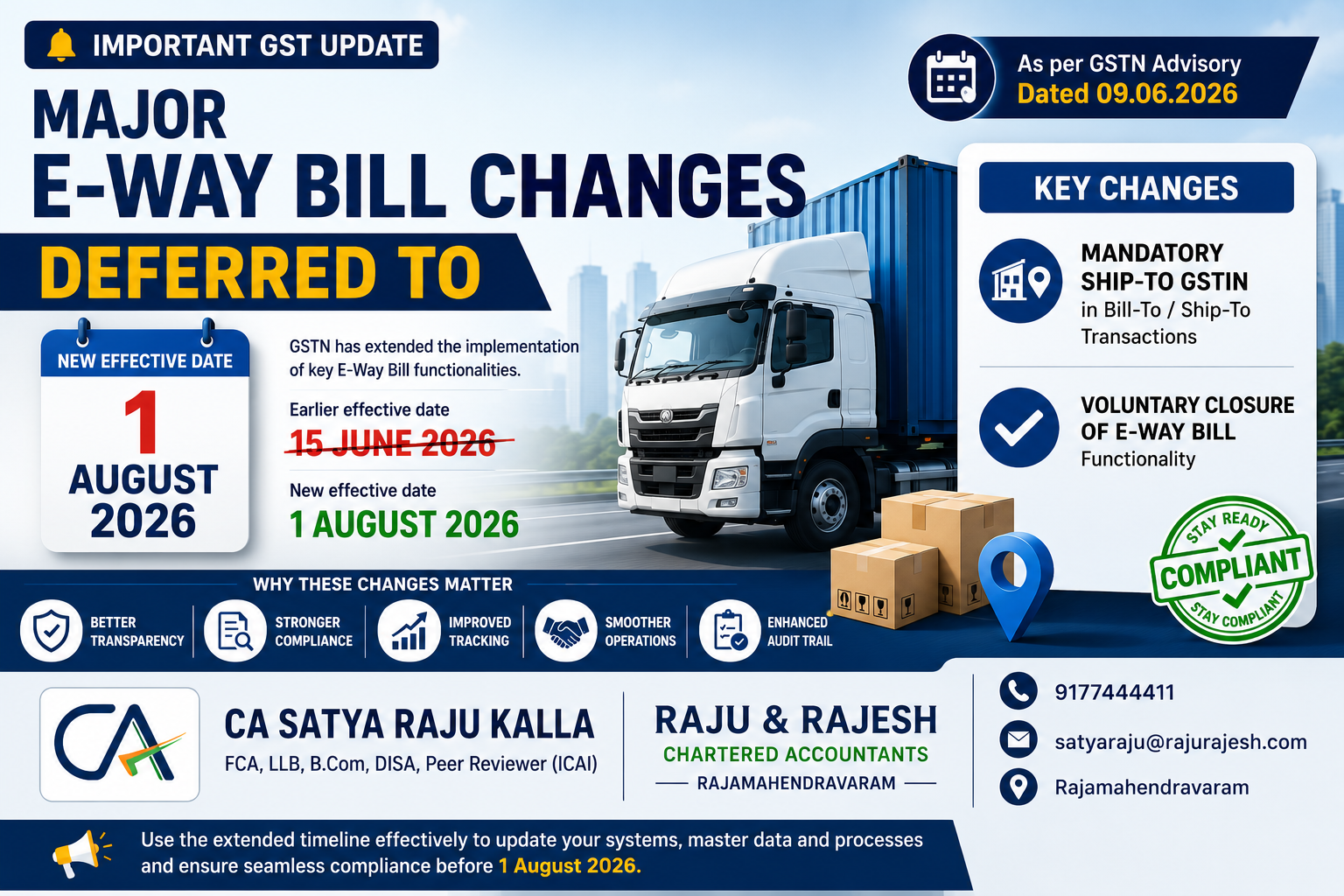
The Goods and Services Tax Network (GSTN) has announced an extension in the implementation timeline for two important E-Way Bill functionalities that were originally scheduled to become effective from 15 June 2026. Based on representations received from trade, industry, ERP providers, and other stakeholders, GSTN has decided to defer the implementation date to 1 August 2026.
The extension provides businesses additional time to update their systems, complete testing, revise master data, and ensure operational readiness before the new requirements become mandatory.
Background of the GSTN Advisory
GSTN had earlier announced the introduction of the following functionalities in the E-Way Bill system:
- Mandatory capture of Ship-To GSTIN in Bill-To/Ship-To transactions.
- Voluntary Closure of E-Way Bill functionality.
These changes were initially proposed to take effect from 15 June 2026. However, after considering requests from industry participants regarding ERP readiness, API integration, system modifications, and data updation requirements, GSTN has postponed the implementation date.
The revised effective date is now 1 August 2026.
Why These Changes Matter
The E-Way Bill system has become one of the most important compliance tools under GST. Tax authorities increasingly use E-Way Bill data for:
-
Verification of movement of goods
-
Detection of fake invoicing
-
Matching of e-Invoice and GST return data
Need help with this? Talk to RAJU & RAJESH → -
Identification of tax evasion
-
Tracking of supply chain transactions
The latest changes are intended to improve the quality and reliability of information available on the E-Way Bill portal.
1. Mandatory "Ship-To GSTIN" in Bill-To / Ship-To Transactions
Existing Practice
In many business transactions, the invoice is raised on one party while goods are delivered to another location.
Example:
-
Manufacturer issues invoice to Dealer A.
-
Goods are directly delivered to Customer B.
Such transactions are commonly known as:
Bill-To / Ship-To Transactions
Under the earlier system, many taxpayers either left the Ship-To GSTIN field blank or did not accurately capture the actual consignee's GSTIN.
New Requirement from 01 August 2026
Where goods are delivered to a registered recipient, the Ship-To GSTIN must now be mandatorily reported while generating the E-Way Bill.
Where goods are delivered to an unregistered person, taxpayers must mention:
URP (Unregistered Person)
instead of leaving the field blank.
Illustration
Scenario
ABC Manufacturers, Hyderabad
Invoice Raised To:
XYZ Traders, Vijayawada
Goods Delivered To:
PQR Industries, Guntur
E-Way Bill Reporting
Bill-To GSTIN:
GSTIN of XYZ Traders
Ship-To GSTIN:
GSTIN of PQR Industries
This will enable GST authorities to identify the actual destination and recipient of goods.
Benefits of Mandatory Ship-To GSTIN
Better Traceability
Authorities can track the actual movement of goods more accurately.
Reduction in Fake Transactions
Misuse of Bill-To / Ship-To arrangements for tax evasion can be minimized.
Improved Data Matching
Helps in reconciliation between:
-
E-Invoice
-
E-Way Bill
-
GST Returns
-
Actual Delivery
Stronger Audit Trail
Creates a complete chain of documentation from supplier to final recipient.
Businesses Most Affected
The following sectors frequently use Bill-To / Ship-To transactions:
-
Manufacturing companies
-
Trading businesses
-
Distributor networks
-
Warehousing operations
-
E-commerce sellers
-
FMCG businesses
-
Pharmaceutical companies
-
Logistics operators
Such businesses should immediately review their dispatch procedures.
2. Introduction of E-Way Bill Closure Facility
What is the New Feature?
GSTN has introduced a facility to formally close an E-Way Bill after successful delivery of goods.
Earlier, after delivery there was no mechanism to indicate that transportation had been completed.
The new closure facility fills this gap.
Who Can Close an E-Way Bill?
The facility can be used by:
-
Supplier
-
Recipient
-
Transporter
-
Driver or authorized person linked through registered mobile number
Benefits of E-Way Bill Closure
Better Record Management
Completed transactions can be formally marked as closed.
Reduced Compliance Risks
Eliminates confusion regarding completed and pending consignments.
Enhanced Monitoring
Businesses can easily distinguish between active and completed deliveries.
Improved Internal Controls
Useful for logistics and inventory management systems.
Important Time Limit
The closure facility can generally be used:
-
On the date of delivery, or
-
On the next day after delivery
Businesses should ensure prompt action to utilize this feature effectively.
3. ERP and Software Changes Required
Organizations using:
- Tally
-
Busy
-
Marg
-
Custom ERP Solutions
must update their systems before 01 Aug 2026
Required changes may include:
-
Addition of Ship-To GSTIN field
-
Validation controls
-
Updated EWB APIs
-
Closure functionality integration
-
Workflow modifications
Failure to update systems may result in E-Way Bill generation failures.
Compliance Checklist Before 01 August 2026
Businesses should complete the following activities:
Review Existing Bill-To / Ship-To Transactions
Identify all business processes involving different billing and delivery locations.
Update Customer Master Data
Ensure Ship-To GSTIN information is available and accurate.
Modify ERP Systems
Configure mandatory validation for Ship-To GSTIN.
Train Staff
Educate:
-
Accounts teams
-
Dispatch teams
-
Logistics staff
-
GST compliance personnel
Test E-Way Bill Generation
Perform trial runs before implementation.
Update SOPs
Revise internal documentation and compliance procedures.
Consequences of Non-Compliance
Failure to comply may lead to:
-
Inability to generate E-Way Bills
-
Delays in dispatch of goods
-
Transportation disruptions
-
Increased GST scrutiny
-
Potential penalties under GST law
Therefore, businesses should treat these changes as an important compliance requirement rather than a mere system update.
Practical Advice for Taxpayers
As Chartered Accountants and GST consultants, we recommend that businesses immediately conduct a review of:
-
Customer master records
-
Delivery location details
-
ERP configurations
-
Dispatch workflows
-
Logistics documentation
The sooner these changes are implemented, the smoother the transition will be after 01 August 2026
Conclusion
GSTN has deferred the implementation of the mandatory Ship-To GSTIN requirement and the Voluntary E-Way Bill Closure facility from 15 June 2026 to 1 August 2026. The extension provides valuable time for businesses, ERP providers, and GST professionals to complete system upgrades, testing, and process improvements.
Taxpayers should use this additional time wisely and ensure complete readiness before the revised implementation date to avoid operational and compliance challenges.
CA SATYA RAJU KALLA
FCA, LLB, B.Com, DISA, Peer Reviewer (ICAI)
RAJU & RAJESH
Chartered Accountants
Rajamahendravaram
📞 9177444411
📧 satyaraju@rajurajesh.com
Have Questions? We're Here to Help
Get expert advice from RAJU & RAJESH. Reach out to discuss your requirements.