
GST Compliance Guide: 14 Important GST Limits Every Business Must Know in FY 2026-27
Goods and Services Tax (GST) compliance is not merely about filing returns on time. Every registered taxpayer, accountant, business owner, and finance professional should be aware of the critical thresholds and limits prescribed under GST law. Missing these limits can lead to penalties, notices, denial of Input Tax Credit (ITC), and unnecessary litigation.
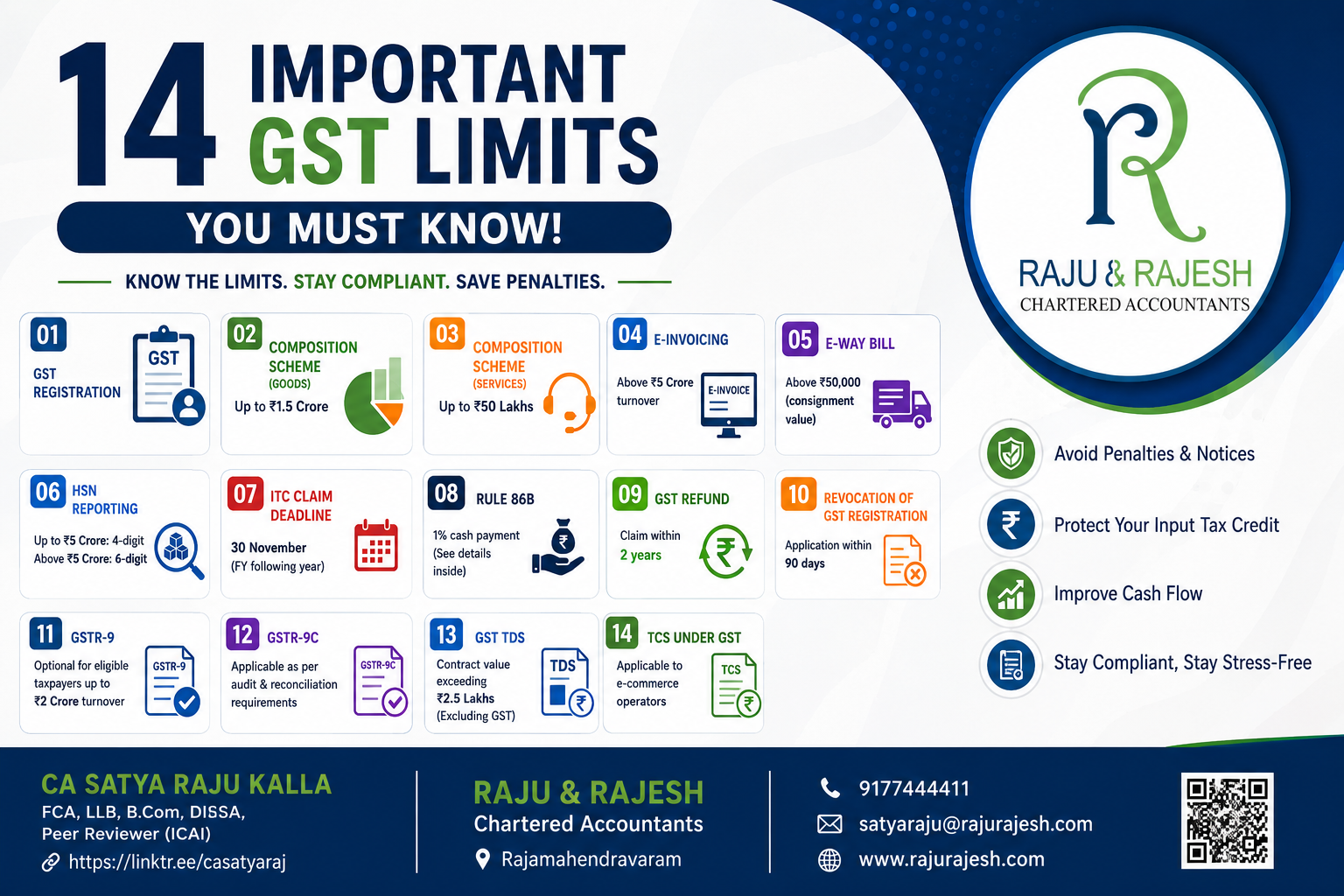
This article summarizes 14 important GST limits that every taxpayer should keep in mind during FY 2026-27.
1. GST Registration Threshold
GST registration becomes mandatory when aggregate turnover exceeds:
-
₹40 Lakhs for suppliers of goods (subject to eligible States and conditions)
-
₹20 Lakhs for service providers
For special category States, lower limits may apply.
Businesses approaching these limits should monitor turnover regularly to avoid delayed registration.
2. Composition Scheme for Traders and Manufacturers
Eligible taxpayers engaged in supply of goods can opt for the Composition Scheme if their aggregate turnover does not exceed ₹1.5 Crore.
Benefits include:
-
Reduced compliance burden
-
Quarterly tax payment
-
Lower record-keeping requirements
However, composition taxpayers cannot collect GST from customers or claim ITC.
3. Composition Scheme for Service Providers
Service providers and mixed suppliers can opt for the special composition scheme if turnover does not exceed ₹50 Lakhs.
The scheme offers simplified compliance and reduced tax burden for small service businesses.
4. E-Invoicing Applicability
E-Invoicing is currently applicable to businesses having aggregate turnover exceeding ₹5 Crore.
Covered taxpayers must generate Invoice Reference Numbers (IRN) through the Invoice Registration Portal before issuing invoices.
Failure to generate valid e-invoices may render invoices invalid under GST law.
5. E-Way Bill Requirement
Generation of an E-Way Bill is generally mandatory when the value of goods being transported exceeds ₹50,000.
Businesses should ensure proper documentation during transportation to avoid detention and penalties.
6. HSN Reporting Requirements
HSN code reporting requirements depend upon turnover:
-
Up to ₹5 Crore turnover – Minimum 4-digit HSN
-
Above ₹5 Crore turnover – Minimum 6-digit HSN
Correct HSN reporting helps avoid return mismatches and notices.
7. Input Tax Credit (ITC) Claim Deadline
ITC relating to a financial year can generally be claimed up to 30th November of the following financial year, subject to prescribed conditions.
Missing this deadline can permanently result in loss of eligible credit.
Businesses should conduct annual ITC reconciliation well before the due date.
8. Rule 86B Restriction
Rule 86B mandates payment of at least 1% GST liability in cash in specified cases where taxable turnover exceeds prescribed limits. https://rajurajesh.com/blog/rule-86b-under-gst
Businesses should review applicability periodically and maintain adequate cash flow planning.
9. GST Refund Time Limit
Applications for GST refunds must generally be filed within 2 years from the relevant date.
Delay in filing may result in forfeiture of legitimate refund claims.
Exporters and businesses accumulating ITC should monitor refund eligibility regularly.
10. Revocation of Cancelled GST Registration
Where GST registration is cancelled by the department, an application for revocation may generally be filed within 90 days from the date of cancellation order, subject to extensions permitted by law.
Prompt action is essential to restore registration and continue business operations smoothly.
11. GSTR-9 (Annual Return)
GSTR-9 filing is optional for eligible taxpayers having aggregate turnover up to ₹2 Crore.
Even where optional, businesses should evaluate the benefits of filing for maintaining proper compliance records.
12. GSTR-9C
GSTR-9C is the reconciliation statement prescribed under GST provisions for taxpayers meeting the applicable criteria.
Proper reconciliation between books of accounts and GST returns is crucial to avoid future disputes and departmental scrutiny.
13. GST TDS Threshold
Tax Deducted at Source (TDS) under GST becomes applicable when the value of a contract exceeds ₹2.5 Lakhs (excluding GST).
Specified government departments, authorities, and notified entities are required to comply with these provisions.
14. TCS under GST
Tax Collection at Source (TCS) provisions apply to e-commerce operators as prescribed under GST law.
Businesses operating through e-commerce platforms should regularly reconcile TCS credits reflected in their GST records.
Why These Limits Matter
Awareness of GST thresholds helps businesses:
-
Avoid penalties and notices
-
Protect Input Tax Credit eligibility
-
Improve cash flow management
-
Ensure timely compliance
-
Reduce litigation risk
-
Strengthen financial controls
GST compliance should not be viewed merely as a statutory obligation. Businesses that maintain robust compliance systems often enjoy better credibility, smoother operations, and improved financial discipline.
Conclusion
The GST framework contains several critical thresholds that directly impact registration, invoicing, return filing, ITC claims, refunds, and taxation procedures. Business owners, accountants, and finance teams should periodically review these limits and ensure timely compliance.
A proactive approach towards GST compliance can save significant costs, avoid disputes, and contribute to sustainable business growth.
Author
CA SATYA RAJU KALLA
FCA, LLB, B.Com, DISA, Peer Reviewer (ICAI)
https://linktr.ee/casatyaraj
RAJU & RAJESH
Chartered Accountants
Rajamahendravaram
📞 9177444411
📧 satyaraju@rajurajesh.com
Have Questions? We're Here to Help
Get expert advice from RAJU & RAJESH. Reach out to discuss your requirements.